
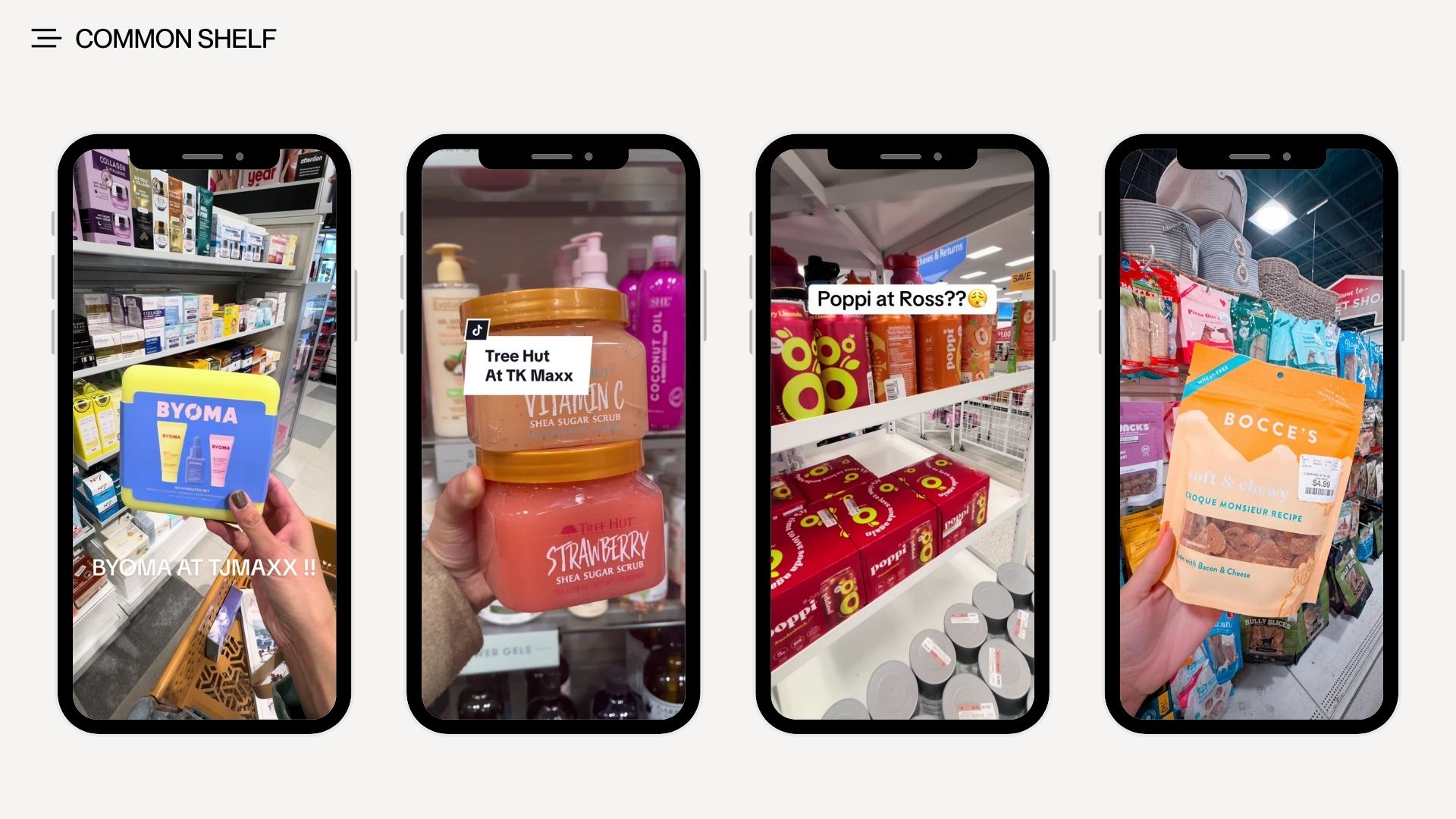
Everyone assumes Gen Z is an “online-only” shopper. The data says something different: social sets the trend, but discovery and validation still happen in-store. This is especially true in beauty, beverage, and pet, and especially in off-price.
1. The Gen Z discovery paradox
For years, everyone assumed Gen Z would skip physical retail entirely.
Instead, we’re seeing a different pattern:
A recent PwC analysis found 61% of Gen Z now prefer to discover new products in-store, a clear swing back toward physical discovery. PwC
YouGov’s 2025 report shows personal recommendations and in-store browsing are Gen Z’s top discovery sources, while 64% use social to research what they’ve already heard about. YouGov
So the flow isn’t “see ad → buy online.”
It’s more like:
Feed sets the idea → friends and creators narrow the list → shoppers check reviews and pricing in the aisle → stores decide what sticks.
That’s the paradox: Gen Z is the most online generation, but they’re using stores, not feeds, for the moment of truth.
And that’s exactly where off-price comes in.
We break down the AI/search side of this shift in more detail in The State of Off-Price in the AI Discovery Era (2025). Zoomed out, the takeaway is simple: search is where they ask questions, stores are where they make choices.
2. Social sets the brief, not the full funnel
Social media still runs the front end of Gen Z discovery, but its job description has changed.
Most Gen Z shoppers now integrate social into their shopping journey: they watch short-form videos, follow creators, and build mental lists of “brands I might try next.” Bazaarvoice
What social really does for this cohort:
Defines “what good looks like.”
Ingredients (prebiotics, SPF 50, ceramides, calming chews), textures (jelly, foam, stick), and formats (daily routines, starter kits) all get pre-loaded in their head.
Sets expectations on price and value.
They see what things cost at Sephora, Ulta, Amazon, Target. By the time they step into a store, they know what feels like a “steal” versus a ripoff.
Creates the missions.
“Hot girl walk,” “Sunday reset,” “skin cycling,” “pet spa day,” “desk snacks.” The store trip is built around content-driven rituals.
Social isn’t replacing physical retail. It’s pre-programming it.
If you’re a brand, that means the question isn’t “Are we on TikTok or in stores?” It’s, “Does the shelf execution (pack, price, placement) line up with the trend brief Gen Z already has in their head?”
3. Why off-price is Gen Z’s default discovery lab
Once you accept that Gen Z uses stores for discovery, the next question is which stores.
The answer: off-price is right near the top of the list.
An ICSC survey cited by Shopify and others found 48% of Gen Z consumers say they most frequently shop at off-price retailers like Marshalls and TJ Maxx, while only 24% say the same for specialty retailers. Shopify
Coverage of back-to-school and apparel shopping shows nearly half of Gen Z say they frequent off-price banners such as TJ Maxx, Marshalls, and Kohl’s for branded pieces and deals. Deseret News
Why this matters:
Budget-safe experimentation.
When a product has been “everywhere” in their feed, off-price is often where Gen Z tests it first. They get the same brand or a close cousin at a safer price point.
Treasure-hunt dopamine.
The off-price model (limited runs, constant rotation, mixed adjacencies) matches how Gen Z already consumes content: Scroll, scroll, scroll, stop, hit.
Content loop fuel.
“Come to TJ Maxx with me,” “Marshalls haul,” and “Ross beauty finds” are all built on this environment. The store itself becomes part of the trend.
If you’re building a modern beauty, F&B, pet, or wellness brand for Gen Z and you ignore off-price, you’re opting out of one of the physical channels they use most to validate trends.
The whole reason we built Common Shelf is to make sure that move into off-price is brand-safe. The guardrails we run with clients are laid out in Off-Price, But Brand-Safe: Our Guardrails.
4. What Gen Z trends look like when they hit the aisle
To see how this plays out, it’s helpful to skim three trend streams Gen Z is already pushing into off-price stores.
4.1 Beauty: clean, K-influenced, and “shelf selfie” ready
Gen Z isn’t just buying viral beauty online; they’re expecting the same standards to show up on shelf.
Industry work from Numerator and others shows that Gen Z is more likely than older cohorts to prioritize:
“Clean” ingredient lists (avoiding sulfates, parabens, etc.),
SPF and skin-barrier benefits,
Cruelty-free and ethical production. Numerator
On shelf, including in off-price, that shows up as:
Simple, outcome-first language: “Barrier repair,” “Glow + hydration,” “Acne-safe,” instead of just “Vitamin C Serum.”
Formats they recognize from TikTok: SPF sticks, lip oils, jelly masks, K-beauty toners and essences.
Packaging that reads well in a selfie: clean layouts, pastels, minimal text, clear bottles.
In a TJ Maxx or Marshalls beauty bay, you can literally see this evolution: old-school boxes with dense claims right next to clean, K-influenced packs that clearly came of age in a TikTok world.
If your brand sits in that bay, the question isn’t just “Are we priced right?” It’s “Do we look like we belong in the feed andthe aisle at the same time?”
We go deeper on translating TikTok proof into TJX shelf velocity in TikTok → TJX Shelf Velocity.
4.2 Functional F&B: hydration and “identity in a can”
Gen Z has also rebuilt parts of the beverage aisle.
Circana data via Beverage Industry shows “modern soda” (gut-health and better-for-you carbonated drinks) hit about $1.8B in sales in 2024, up 83% from the year before. Brands like Poppi and Olipop dominate that slice. Beverage Industry
Big CPG is reacting:
PepsiCo bought prebiotic soda brand Poppi for nearly $2B to get a foothold in functional drinks as traditional soda demand softens. Reuters
What this tells you:
Gen Z doesn’t just want “less bad” soda, they want beverages that signal gut health, energy, mood, or lifestyle.
The can itself is part of the purchase: color, typography, and copy are as much about identity as about ingredients.
When those products land in off-price (overruns, new flavors, short-dated inventory), the aisle becomes a low-risk way for Gen Z to audition a brand they’ve seen online.
If you’re a functional beverage founder, that’s the job: show up in off-price with packs and price points that say, “This is the trending soda you’ve been seeing all over your FYP, here’s your chance to try it without paying full freight.”
4.3 Pet: human-grade expectations in the pet aisle
Pet is the clearest example of Gen Z treating another category like personal care.
APPA’s 2025 State of the Industry report shows:
In 2024, Gen Z made up 20% (18.8M) of U.S. pet-owning households, a 43.5% increase vs. 2023.
70% of Gen Z pet owners have two or more pets, making them the generation most likely to live in multi-pet households. American Pet Products Association
That’s not just “we like dogs.” It’s a pet-first lifestyle.
On shelf, that translates to:
Supplements and treats that look like human wellness: gut health chews, calming bites, joint support, all with clean, modern packaging.
Grooming products that borrow from beauty: sensitive-skin shampoos, fragrance-free formulas, “spa day” bundles.
Aesthetic add-ons: bowls, leashes, toys designed for Instagram and TikTok.
When those products show up in off-price, Gen Z reads them the same way they read beauty and beverage:
Does this match the values, aesthetics, and routines I’ve already built online, just at a friendlier price?
5. The sustainability and values filter
Underneath all of this is a values layer Gen Z is applying everywhere, especially to packaging.
McKinsey’s global packaging work finds younger consumers (Gen Z + Millennials) have the highest stated willingness to pay more for sustainable packaging. McKinsey & Company
First Insight’s research shows 62% of Gen Z prefer to buy from sustainable brands, and 73% are willing to pay more for sustainable products overall. First Insight
That matters in off-price because:
Sustainable or minimal packaging stands out even more when it’s sitting in a sea of older, over-designed, or less considered packs.
Clear, specific claims (“made with 50% PCR,” “aluminum-free,” “reef-safe”) help Gen Z feel like they’re getting a deal without compromising the values they talk about online.
In other words: a discounted price doesn’t give you permission to ignore the sustainability brief. If anything, it’s where you can prove you know how to deliver both value and values at once.

Latest in Off-Price
